It’s been a while

So, in the time I’ve been busy being a new parent, my brother-in-law has been busy impressing people with his writing. Though, admittedly, I am rather jealous of his achievements and I not-so-secretly wish I could beat him, I would love to share his stories with you.

Since the first story of his that I linked, he has had two more honourable  mentions and a win. Go have a look at the stories written by Riaan Els!

I honestly think I’d enjoy and hate working on a collaboration with him. Enjoy, because he has innovative ideas and definitely does not think like I do. And hate, because he is obviously very talented (making me feel like a dud) and definitely does not think like I do.

Setbacks

I took part in NaNoWriMo in November, but I never finished. No, it wasn’t just the usual: I gave up. I went through a really rough time when my cat was poisoned and died. She had been part of the way I wrote and actually contributed more than I had realised when she had been around. Every time I even thought about writing, I would crumble and cry uncontrollably.

It took me a month and a half to finally gather the courage to write without her. And then I could only work on pieces that contained no emotional content.

In the end, I had stopped my NaNoWriMo attempt at ±32 000 words. I was still perfectly on target at that point. If I had been able to keep going at the same pace, I’m sure that I would have succeeded in writing the required 50 000 words in 30 days.

Now, at the end of December (2012), I am about to go into labour and there is just no way I can predict how much I will be able to get done in a day. It might sound silly to someone who has never been pregnant, but it is really not easy to concentrate or gather enough motivation to write more than 300 words in one go anymore.

I’m super uncomfortable. I can hardly walk half the time (read up about “symphysis pubis dysfunction” if you think I’m exaggerating). My porridge brain is also pretty bad at the moment. My husband’s been laughing himself silly at the strange spoonerisms and incoherencies I have been committing. This is hardly conducive to meaningful writing.

It looks like I’ll have a pretty full schedule once my baby settles into a more predictable routine next year. I’m hoping to start getting back to about 500 words a day in April. So, the blog will probably also be very quiet until then. *sigh* Such is life, n’est ce pas?

NaNoWriMo, here we come!

The countdown has started and soon writers taking part in NaNoWriMo will fall off the map for 30 days. Kick-off parties are being held and preparations are being made in the form of notes, notifications to family and friends, acquisition of writing aids (like snacks, music and writing buddies) and extensive mental preparation.

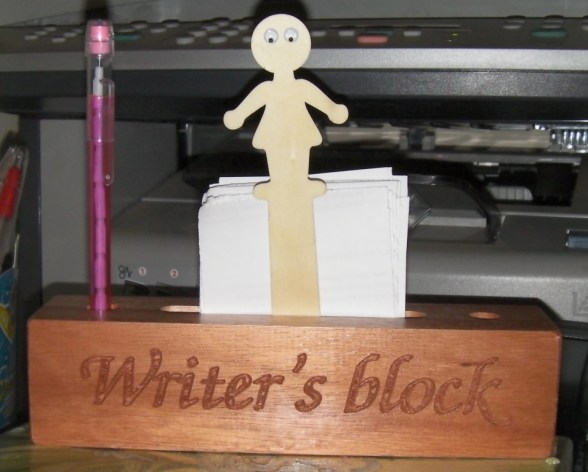
At my local kick-off party (go see pics at a fello WriMo’s blog), I met some of my fellow writers in the Pretoria (South Africa) region. Some were very vocal, some were very quiet and some were those gems of people who actually went to a lot of effort to welcome old and new participants. I now have a Writer’s Block sitting on my desk (okay, fine, it’s sitting on my calligraphy box on my desk), two plot bunnies (a blue origami bunny I folded myself and a plush bunny I actually won), my inner editor – soon to be incarcerated – and a tiny, noisy stress ball.

One of the most useful things I got was the little inner editor stick girly (you will see her in the feature pic). How on earth is this little googly-eyed ice lolly stick supposed to be of any help, you ask? Well, first off I need to explain the concept of inner editors.

The inner editor is that part of any writer that nitpicks about everything from spelling, grammar, character inconsistencies to plot holes. The sad part is, for most writers, this inner editor is a crippling, mean-spirited critic telling them that their work is terrible and that they should do the world a favour and just stop writing. And because this inner editor is a part of you, it knows exactly how to get you down in the dirt and keep kicking you where it hurts.

So, to make sure that my inner editor does minimal damage to my word count during November, I’m going to make a little cage for the effigy I have been provided with. Every time I start going back and changing things I suddenly realise don’t make sense or make the story sound stupid or are unusable for some other obscure reason, I will look at my incarcerated inner editor and smirk at it. In the words of Silver Knight Gothic (Dragon Hunters), I shall tell it firmly, “I do not fear you, ugly thing! My heart is pure as a freshwater spring!” and simply continue writing.

Best of luck to all the WriMos out there!

Science Fiction

As a subgenre of fantasy, Science Fiction (or SciFi, as most of us call it,) is actually a broad genre on its own. There are very few hard and fast rules for this subgenre. It can be far in the future, like Battle Star Galactica, or even a “long, long time ago”, like Star Wars. The only real factor is technology or a not-yet-realised scientific future.

Some SciFi is very pointedly a story that takes place in space (any space that’s beyond the Earth’s atmosphere, really) – think Star Trek or Alien – but others may use Earth or a planet like Earth to give the story a more subtle SciFi angle – Æon Flux and Real Steel can give you a bit of insight on this angle.

If you have looked at some of the older SciFi, you will even see that some of the elements that were Science Fiction in those days, are now a reality – like the Internet and nano-machines.

Popular themes:

  • Space exploration
  • Intergalactic politics with alien races
  • Aliens
  • Bio-engineering
  • Nanotechnology
  • Reviving extinct species (think Jurassic Park)
  • Colonisation of other planets/solar systems
  • Space pirates
  • Bionics
  • Robots
  • Cyborgs
  • Artificial Intelligence (AI)
  • Domination of the human race by aliens/machines
  • Mystical forces from space (2001: A Space Odessy, AvatarStar Wars  and many more)
  • Alternate realities
  • Mutliverse
  • Time travel
  • Teleportation
  • And lots, lots more…

It’s really so broad, one could write volumes about this subgenre. But, for me, it is important to note that it can easily be used as a flavour in the other fantasy subgenres. Examples of fantasy that typically contain SciFi elements are: Steam Punk, Cyberpunk, Dying Earth and Other Planet.

Never for a moment think that subgenres are mostly found in their pure forms. The very way they have found their way into existence is by developing from other forms of the main genre. The rules are hardly ever set in stone.

NaNoWriMo

So, National Novel Writing Month is just around the corner. Every year in November, this organisation encourages writers (and aspiring writers) from across the world to attempt writing a whole book in one month. Having had contact with writers who have attempted this before, I have been put under the firm impression that this challenge is not for sissies.

Writing 50 000 words in 30 days is a massive undertaking…especially if you have a life that is notorious for happening at you a lot. Some writers do this in their spare time. Some writers dedicate every waking moment to it. Some simply write to write. Some write to make progress on novels they have been planning for a while.

However you look at it. It is a massive achievement to have written 50 000 words in a month. It comes down to writing 1666+ every day for 30 days. 1666+ might not sound like a lot, but if you want to write anything resembling an actual story, you might run into some difficulties in filling that quota. Just ask some of the veterans and look at the amount of ‘beat the block’ kind of links on the main page, and you’ll quickly realise that very few writers don’t get stuck.

I might just be idealistic, but I hope to use this year’s NaNoWriMo to get my writing habit firmly settled and to prove to myself that I can, in fact, write a 300 000-word novel in less than a year.

Good luck to all the writers taking on NaNoWriMo this year! May your fingers find their way on your keyboard and may your ideas flow like the mighty Amazon. We can do this!

The deeper meaning

When I was studying languages at uni, I had to wade through three years of soul-crushing literature analysis courses for English. We tore books apart and analysed aspects of characters that the author never gave a second thought. I hated it with a passion. It felt like we were putting messages in the authors’ mouths and claiming that they had meant to communicate them.

Then, after I had finished my degree, I realised movies and books had ultimately changed for me. I saw patterns and themes. I followed character growth, regression or lack of either. I was far more aware of stilted story telling and (actually mostly) lack of plot. As a matter of fact, for a few years, I didn’t enjoy any of the stories I read or watched. My uni training had made me too critical. Even good stories have plot holes and inconsistencies.

Then came a turnaround for me. My husband was following the Sword of Truth series by Terry Goodkind and I decided to try and catch up to him. Though the main characters’ whining got to me more than the first time I had read the first book, I was just enjoying it. But in book five I found my gripe: I had realised that the underlying moral of every book came down to how people become brainwashed by their community or circumstances to believe things regardless of proof that indicates otherwise.

At first, I was disappointed to realise that all those books had that theme. It took all the fun out of the reading for me. But, then, it dawned on me: Every author has some sort of message. Every author has a need to express some truth about life. For Goodkind, it’s a journey with his readers to lead them to disillusioned awareness about the influences in their lives. For me, it’s most notably about the awareness that people are all broken in some way and that your own, unique brokenness does not have to get in your way to becoming awesome.

Have you found deeper messages buried deep in the pages of the books by your favourite author?

Some of the deeper messages I have encountered:

  • Things are not what they seem
  • Do not judge on first appearances
  • We are destroying the planet with our own ignorance
  • All people are alike deep down inside
  • Everyone just wants to be heard
  • Words can destroy more easily than they create
  • The road to Hell is paved with good intentions

Science Fantasy – Dying Earth

Dying Earth* is a very emotional subgenre for me – though, the story itself may be written as overtly devoid of emotion. As the name suggests, Earth is no longer the lushly green planet we know. Because of some sort of catastrophe, be it a literally earth shattering war, the Earth getting hit by a massive meteor, humans simply using up the Earth’s natural resources or a myriad of other apocalyptic events, nature is destroyed (or very nearly destroyed).

Stories may take place on Earth itself or on another planet, because earth is now dead or dying. The main focus may be on the fact that Earth can no longer sustain life (or in the very near future) or it may be a background detail.

This is a flavour that pulls at the heart strings of every tree hugger or nature lover out there.  Being one of these individuals, I can honestly say that this genre is in one breath demotivational, heart wrenching, beautiful and very inspiring. Avatar, the movie with the large blue cat people, makes me want to recycle my neighbour’s trash as well, blat polluters over the head and become an amazon every time I watch it.

*Note that the planet in question is not necessarily Earth, it may be another planet or moon…or whatever the people of the story call home.


Examples include:

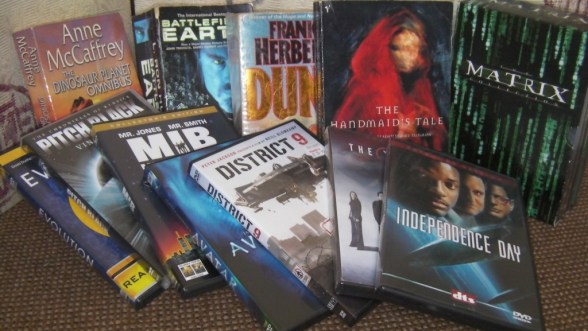
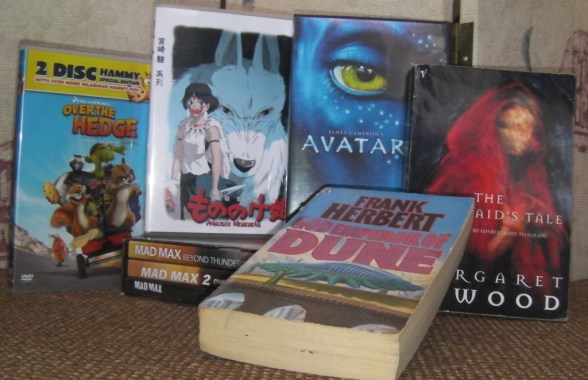
  • A Handmaid’s Tale – Margaret Atwood
  • Dark Sun (the Dungeons&Dragons books and role playing setting) – set on a fantasy world
  • Dune books – Frank Herbert – set on a world where the introduction of verdant life destroys arguably the most valuable source on the planet
  • Avatar  (movie)
  • Waterworld (movie)
  • Princess Mononoke (animé movie)
  • Mad Max (movie)

Science Fantasy – Other Planet

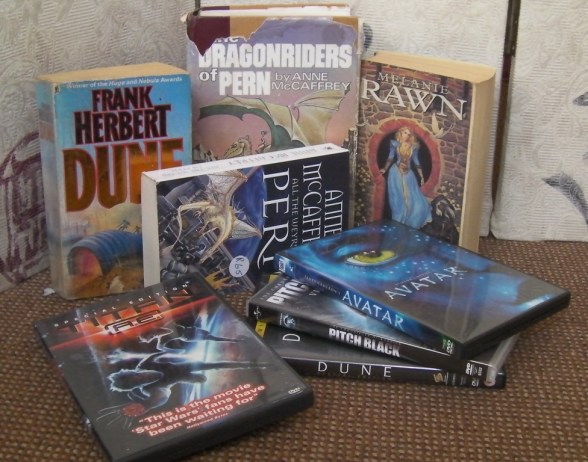
Science Fantasy is any form of fantasy that does not exclude technology as a whole. This means that it can be set in almost any time period (meaning, the setting can appear to be mostly mediaeval like Melanie Rawn’s The Ruins of Ambrai or it can be in a futuristic setting like Frank Herbert’s Dune). There are two main subgenres under this banner: Other Planet (this post) and Dying Earth (next post).

In Other Planet stories, the story takes place on another planet and may or may not include in-your-face technological advances. I originally thought I wasn’t entirely sure that I’ve encountered this kind of fiction, but, as I sat down to think about it, I realised that I have books by different authors and even some movies on DvD that are set on other planets – but are still fantasy.

To be fair, the Dying Earth stories often spill over into Other Planet stories. So, these two subgenres are really not typically used in exclusion of each other.

In a purely Other Planet setting, humans have typically ventured into space and have started colonising other planets, though humans may have been forcibly taken to the other planet(s) by alien races. Humans may or may not be taking colonisation overboard. There may or may not be other races/alien races. In some stories, the fact that it is a planet other than earth hardly ever come up as a theme. In others, the fact that Earth is the original planet the humans come from is part of the normal facts and it is often referenced.

Examples of Other Planet in literature include:

  • Melanie Rawn – The Exiles: The Ruins of Ambrai
  • Anne McCaffrey – The Dragon Books (there are many)
  • Frank Herbert – Dune

And in the movies:

  • Titan A.E.
  • Pitch Black
  • Avatar

The write priorities

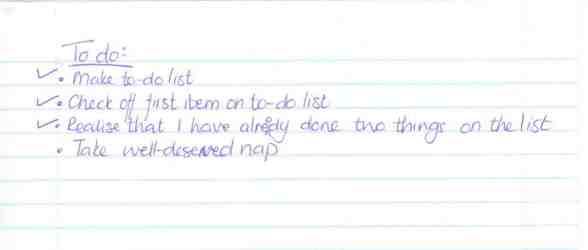
To-do List

Every so often you find yourself just not doing what you thought you would. For instance, I planned to enter at least one competition per month, write at least one blog entry per week and write at least 1000 words per day on either my fantasy story or my self-help book. But, I have found that it often becomes an either or situation.

During weeks where I manage to average 1000 words a day, I don’t get around to my blog and forget entirely about the competitions. During weeks where I write my blog entries, I get to maybe 2000 words total of story/self-help book. During months where I enter a competition, I inexplicably feel like my goals have been met and I just can’t concentrate on writing enough to actually write more than two blog entries and maybe 5000 words of story/self-help book.

It may sound silly, especially considering that I have about six hours a day to accomplish these meagre goals. But then, there are the endless chores and need-to-do’s around the house; the friends I haven’t seen in months who treat me to lunch; my general distractedness as an expectant mother (first child and everything); and the need to rest somewhere along the line.

At least I can promise you a short story during next month. I managed to write one this morning (for a competition with the driest topic ever). And I plan to actually write a bit on my story and my self-help book after lunch. All productive I am today!

Bangsian Fantasy

Bangsian Fantasy

Bangsian Fantasy, in my experience, is not a very widely-spread subgenre. It can be set in a whole range of realities, from our reality as we know it to a reality very close to ours, to something that is purely a flight of the imagination. It’s one binding characteristic is the featuring of a historical figure from our reality.

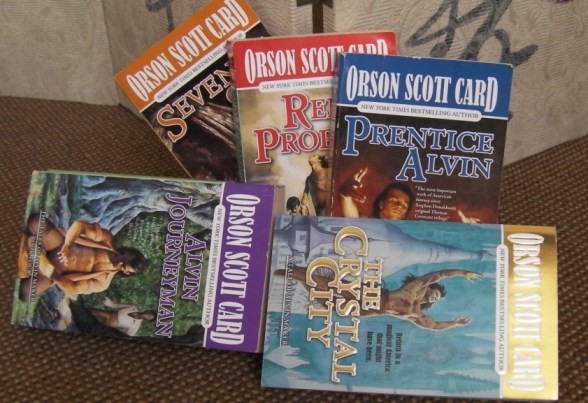
Since I really can remember reading only one series featuring Bangsian elements, I will have to use it as my basis here. Orson Scott Card’s Alvin Maker books don’t actually focus on the historical figures, but they do feature here and there. These books use a version of the world where things have happened a little different to what we see in the history books. The description you usually see on his books refer to “a magical America that might have been”. Napoleon Bonaparte specifically features in these books, having the ability to make people adore and obey him – yes, a maaaagical ability.

Now that I think of it, I’m fairly sure you are likely to find Bangsian elements in Steam Punk books and movies…also in Dark Fantasy.

Wikipedia gives a few examples of Bangsian Fantasy I have never read, so, you might want to check that out too.